
WELCOME BONUS 300%
UP TO €2000 + 100
FREE SPINS
UP TO €2000 + 100
FREE SPINS
Home → Games
Casino games at Vulkan-Vegas-Casinos
Roulette Wheel with 37 vs 38 Pockets
The American Roulette wheel features 38 sectors, including both a single zero (0) and a double zero (00). This design results in a house edge of 5.26%, a significant increase compared to European-style roulette. For example, a straight bet on a single number pays 35:1 on both wheels, but the mathematical odds are worse with the extra pocket.
In contrast, French Roulette with the La Partage rule for even-chance bets offers a more favourable house edge of 1.35%. This rule returns half of the stake when the ball lands on zero, effectively halving the casino's advantage on bets like red/black or odd/even. The payout for these bets remains 1:1, but the return of half the stake mitigates losses.
The presence of the double zero on the American wheel significantly impacts the player's return. While payouts for inside bets like Split (17:1) and Corner (8:1) are the same as on a 37-sector wheel, the increased number of outcomes means the house keeps a larger portion of all wagers over time.
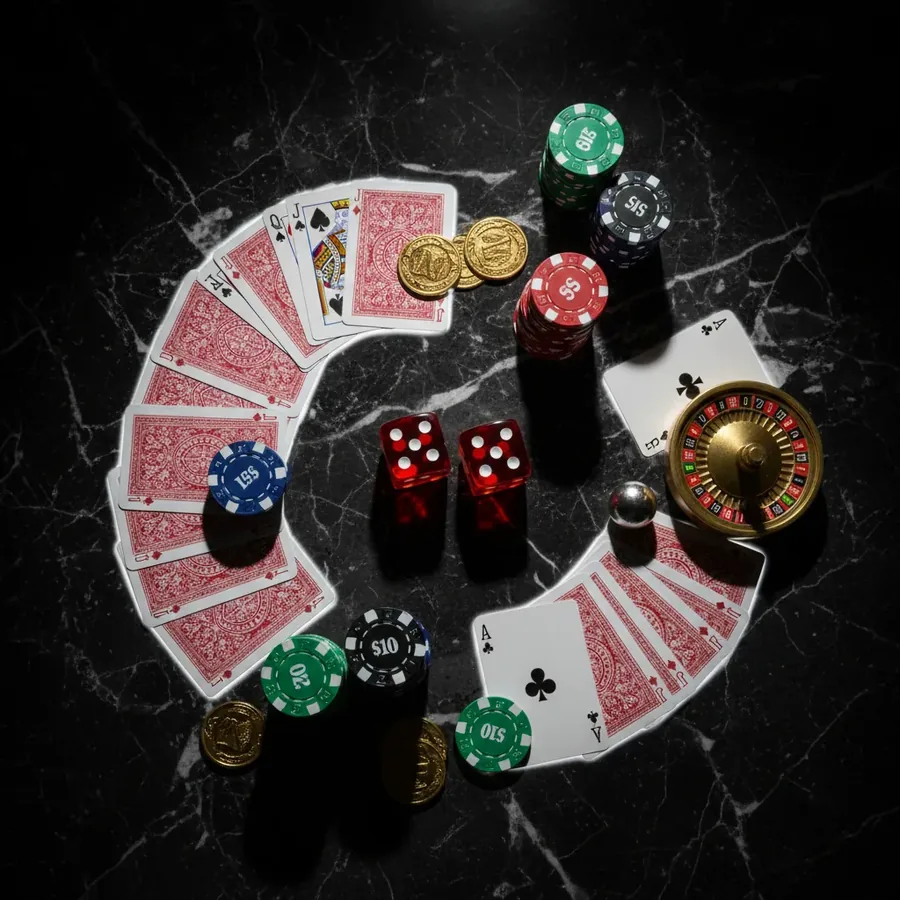
Baccarat commission: 5 percent on each Banker win
In Baccarat, bets placed on the Banker hand are subject to a 5% commission on winning bets. This means that a winning Banker bet pays out at 0.95:1 instead of the standard 1:1. The theoretical RTP for the Banker bet, considering this commission, is 98.94%, with a house edge of 1.06%.
This commission is designed to offset the slight statistical advantage the Banker hand typically holds due to the rules of drawing a third card. Without this commission, the Banker bet would represent an even greater advantage for the player. The Player bet, on the other hand, offers a 1:1 payout and has a slightly lower RTP.
For a player betting €10 on the Banker and winning, the payout would be €9.50 after the 5% commission is deducted. This structure makes the Banker bet the most mathematically sound option within Baccarat, despite the small fee levied on wins.
Straight, Split, and Corner in direct comparison
When wagering on European Roulette, a Straight bet on a single number offers a payout of 35:1. This bet has a high risk but also a high potential reward. The RTP for all bets on a single 37-sector wheel, assuming no special rules like La Partage, is 97.30%, with a house edge of 2.70%.
A Split bet, which covers two adjacent numbers on the roulette layout, pays 17:1. This bet offers a more balanced risk-reward profile than a Straight bet, with a higher probability of a smaller win. The mathematical odds are adjusted to reflect the increased chance of hitting one of the covered numbers.
The Corner bet, also known as a Square bet, covers four numbers that meet at a corner on the betting grid and pays 8:1. This bet provides a broader coverage of numbers compared to Split and Straight bets, further increasing the frequency of wins but at a lower payout multiplier.
Keno and Bingo with RTP Between 92 and 95
This range indicates a higher house edge compared to many other casino games. For example, a 92% RTP means an average of 8% is retained by the casino over the long term.
These games often feature a significant house advantage due to their lottery-style mechanics and the vast number of possible outcomes. For instance, in Keno, players select numbers, and the game draws random numbers; the more numbers matched, the higher the payout, but the odds of matching many numbers are extremely low. This structure inherently leads to lower RTPs.
Compared to games like Blackjack with optimal strategy yielding RTPs close to 99.72%, or even American Roulette at 94.74%, Keno and Bingo present a less favourable mathematical proposition for players. This means that, on average, players are likely to lose a greater percentage of their wagers over extended play sessions.
37 vs. 38 Sectors: What the Double Zero Costs
The inclusion of a double zero (00) on an American Roulette wheel, bringing the total number of sectors to 38, significantly increases the house edge. Standard European Roulette operates with 37 sectors, including a single zero. This single additional pocket on the American wheel raises the house advantage from 2.70% to 5.26%.
Consider the impact on a €10 bet. On a European wheel with a 2.70% house edge, the expected loss per spin is approximately €0.27. However, on an American wheel with a 5.26% house edge, the expected loss for the same €10 bet increases to €0.53, more than doubling the casino's average retained amount per wager.
This mathematical difference means that for every €100 wagered on American Roulette, players can expect to lose approximately €5.26, whereas on European Roulette, the expected loss is closer to €2.70. This disparity makes the 37-sector wheel a more player-friendly option in the long run.
Game categories at a glance
| Category | Examples | Stakes From | Highlight |
|---|---|---|---|
| Slots | Immortal Romance, Extra Chilli Megaways, Big Bamboo | 0,10 EUR | thousands of titles |
| Table games | Roulette, Blackjack, Baccarat | 0,50 EUR | classic rules |
| Live casino | Blaze Roulette, Baccarat Squeeze | 0,20 EUR | real dealers |
| Jackpot games | Mega Moolah, Divine Fortune, Age of the Gods | 0,20 EUR | progressive pools |
| Instant games | Aviator, Plinko, Mines | 0,10 EUR | fast rounds |
| Video poker | Jacks or Better, Deuces Wild | 0,25 EUR | strategy based |
Dozen 2:1 Hits 12 of 37 Numbers
In French Roulette, the Dozen bet covers 12 specific numbers out of a total of 37, offering a 2:1 payout. The house edge on these bets, when La Partage rule is not applied, stands at 2.70%. This means for every 100 EUR wagered on dozens, approximately 2.70 EUR is expected to be retained by the casino over the long term.
This bet type provides a frequency of wins that is higher than a single number bet, which pays 35:1 but covers only one number. With a 2:1 payout for 12 numbers, the mathematical expectation is designed to favor the house. For instance, a 1 EUR bet on a dozen would return 3 EUR if successful.
When considering the French Roulette table without La Partage, a 2 EUR bet on a dozen would yield 4 EUR in profit if it lands. The house advantage of 2.70% on this bet is comparable to the overall house edge on European Roulette. Players should note that inner bets do not benefit from the La Partage rule.
Video Poker 9/6: What the Two Numbers Mean
The '9/6' designation in Video Poker, specifically for Jacks or Better, refers to the payout ratios for a Full House and a Flush, respectively. A 9/6 machine pays 9 coins for a Full House and 6 coins for a Flush, relative to the number of coins bet. This offers a Return to Player (RTP) of 98.39%.
Compared to a '9/5' machine, which offers a 98.45% RTP, the difference in payout for a flush results in a slightly lower theoretical return for the player. For example, a 5-coin bet on a 9/6 machine yields 45 coins for a Full House and 30 coins for a Flush.
The Jacks or Better 9/6 Video Poker variant provides a house edge of 1.61%, making it a popular choice for players seeking a reasonable return. While the 8/5 version has a lower RTP of 97.29%, the 9/6 version offers a more favorable payout structure. Optimal strategy is crucial for achieving these RTP figures.
Columns and Dozens Pay 2:1 in Roulette
Bets on either of the three dozens (1-12, 13-24, 25-36) or the twelve numbers in one of the three columns on a Roulette table typically pay 2:1. In French Roulette, with the La Partage rule applicable to even-money bets, the house edge on these outside bets is reduced to 1.35%.
The American Roulette variant, with its double zero (00), significantly increases the house edge to 5.26% on all bets, including columns and dozens. This is due to the presence of 38 pockets instead of 37, making the mathematical odds less favorable for the player.
A 1 EUR bet on a dozen or column in European Roulette, assuming the La Partage rule applies, would return 3 EUR if successful, including the original stake. However, without La Partage on inner bets, or on an American wheel, the house retains a larger portion of wagers over time.
Bankroll for 200 Rounds at 1 EUR
To play 200 rounds at 1 EUR per round, a bankroll of 200 EUR is required. This assumes no progressive betting or increases in stake size during play. For example, a player betting 1 EUR on the Pass Line at Craps, which has a house edge of 1.41%, would theoretically lose 2.82 EUR over 200 rounds.
If a player opts for French Roulette with La Partage, betting 1 EUR on an even-chance bet (like Red/Black) with a house edge of 1.35%, the expected loss over 200 rounds would be 2.70 EUR. This illustrates the impact of the house edge on the bankroll.
For a player solely focused on maximizing playtime with a 200 EUR bankroll, placing 1 EUR bets on games with a lower house edge, such as Baccarat Banker at 1.06%, would be more conducive. The expected loss over 200 rounds would be 2.12 EUR, allowing for more rounds of play.
Split, Double, and Surrender: Three Decisions Explained
In Blackjack, the 'Split' option allows a player to divide a pair into two separate hands, each with its own subsequent card, when the first two cards dealt are of equal rank. This decision is often based on the player's hand and the dealer's upcard, and is a key element of basic strategy.
Doubling Down (Double) permits a player to double their initial bet after receiving their first two cards, in exchange for receiving only one more card. This move is typically made when the player has a strong starting hand, such as a total of 10 or 11, facing a potentially weak dealer upcard.
Surrender, available in some Blackjack variations like Vegas Strip, allows a player to forfeit half of their bet and give up their hand after the initial deal, especially when facing a strong dealer upcard like an Ace or a 10. This is a strategic option to mitigate losses, with a house edge of 0.28% in liberal Vegas Strip rules.
Straight 35:1 Against the Chance of 1 in 37
A straight bet on a single number in European Roulette, often referred to as Plein, offers a payout of 35:1. This bet covers one specific number out of the 37 available sectors on the wheel, including the single zero.
Compared to American Roulette's 38 sectors, which include both 0 and 00, the single-number bet in European Roulette presents a better mathematical proposition. The house edge on a straight bet in European Roulette is 2.70%, significantly lower than the 5.26% found in American Roulette.
For players aiming for the highest potential single-number payout, the 35:1 return is attractive. However, the underlying house edge means that over an extended period, the casino retains an average of 2.70% of all wagers placed on these single numbers.
La Partage applies only to even money bets
The La Partage rule in French Roulette significantly improves the player's odds on even money bets. This rule applies when the ball lands on zero, refunding half of the player's stake on bets like Red/Black, Odd/Even, or High/Low.
When La Partage is active, the house edge on even money bets in French Roulette is reduced to 1.35%. This is a substantial improvement compared to the 2.70% house edge on the same bets in French Roulette without La Partage, or the 5.26% in American Roulette.
This rule offers a tangible benefit to players engaging in frequent even money wagers. For instance, a player placing a €10 bet on Red, which then lands on zero, would receive €5 back, effectively mitigating losses on that spin.
Punto Banco: 5 Percent Commission on Banker Wins
In Punto Banco Baccarat, the Banker bet is a popular choice due to its favourable odds. A 5% commission is applied to all winning Banker bets, slightly reducing the gross payout.
This 5% commission effectively means that winning Banker bets pay out at 0.95:1, rather than the standard 1:1. Despite this deduction, the Banker bet still holds a superior house edge of 1.06% compared to the Player bet.
The Banker bet's mathematical advantage arises from the probabilities associated with the third card draw. This commission structure ensures the casino maintains a small but consistent edge over the long term, with an RTP of 98.94% on Banker bets.
Baccarat in three steps: bet, reveal, compare
Baccarat, specifically the Punto Banco variant, unfolds over a series of distinct phases. Players first place their bets on either the Player, Banker, or Tie outcomes.
Following the betting round, two cards are dealt to both the Player and the Banker positions. The scores are then tallied based on the card values, with face cards and tens counting as zero, and Aces as one.
The game progresses with potential third card draws dictated by specific rules, after which the hand closest to a total of nine is declared the winner. Winning Banker bets incur a 5% commission, contributing to the game's 1.06% house edge.
Plein Pays 35:1, Cheval Pays 17:1
In Roulette, a 'Plein' bet, which is a wager on a single number, pays out at odds of 35:1. This bet is placed on one specific number out of the 37 available on a European Roulette wheel.
A 'Cheval' bet, also known as a split bet, is a wager on two adjacent numbers. This type of bet pays out at odds of 17:1, reflecting the increased probability of winning compared to a single number bet.
These payout structures are fundamental to Roulette's mathematics. The 35:1 for a Plein bet and 17:1 for a Cheval bet are standard across many European Roulette variations, influencing the overall house edge of 2.70%.
Contact
Live - online chat
Banking









Providers












Vulkan Vegas Casino 2026